


Modernizing Legacy Systems with AI Enhancements Instead of Full Rebuilds: A Practical Middle Path
23 May 2025 | Right Firms
Why Legacy Still Lingers in Modern Enterprises
Legacy systems are often seen as digital fossils—old, immovable, and overdue for extinction. But for enterprise leaders, ripping out mission-critical systems built over decades isn’t just impractical, it’s risky. These platforms still run core banking, public welfare, manufacturing operations, and insurance processing for millions. However, their fragility and complexity grow every year.
Here’s the catch: Full system rebuilds are prohibitively expensive and rarely stay on schedule. A recent study found that 72% of rebuild efforts overshoot budgets by 40% or more. So, what’s the alternative?
Welcome to the “middle path”—a hybrid modernization model where AI-powered enhancements upgrade legacy systems incrementally, cutting costs and minimizing disruption while still preparing enterprises for a digital future. Many organizations are discovering success through Application Modernization Strategies that balance risk, cost, and innovation.
Understanding the Modernization Spectrum
Modernization isn’t binary. It’s a spectrum, ranging from:
- Rehosting (lift-and-shift to cloud)
- Replatforming (changing runtime environments)
- Refactoring (tweaking code without altering core logic)
- Rebuilding (starting from scratch)
Most companies are stuck in the middle, unsure whether to maintain outdated systems or embrace risky overhauls. For example, major financial institutions still run on 40-year-old mainframes, not because they want to, but because rebuilding from scratch could take years and cost tens of millions.
Here’s where AI-enhanced modernization shines. It introduces a gradual, intelligence-led strategy that leverages AI to interpret legacy code, enable smart transitions, and optimize performance over time, all while preserving system stability and business continuity. In this regard, Legacy System Modernization becomes a vital approach to safeguard institutional knowledge while evolving technology stacks.
The Business Case: Why AI-Augmented Modernization Makes Sense
Let’s talk about numbers.
- Maintaining a legacy mainframe costs $3–5 million per year.
- A full cloud migration? $12–18 million upfront.
- AI-powered incremental modernization? Up to 60–80% savings.
And that’s not just theory.
In 2025, a federal IT study showed that AI-assisted documentation reduced legacy knowledge transfer from 9 months to just 6 weeks. Using this method, production incidents fell by 68%, all while ensuring 100% backward compatibility.
This isn’t hype. It’s a shift in modernization economics.
Core Techniques of AI-Driven Legacy Modernization
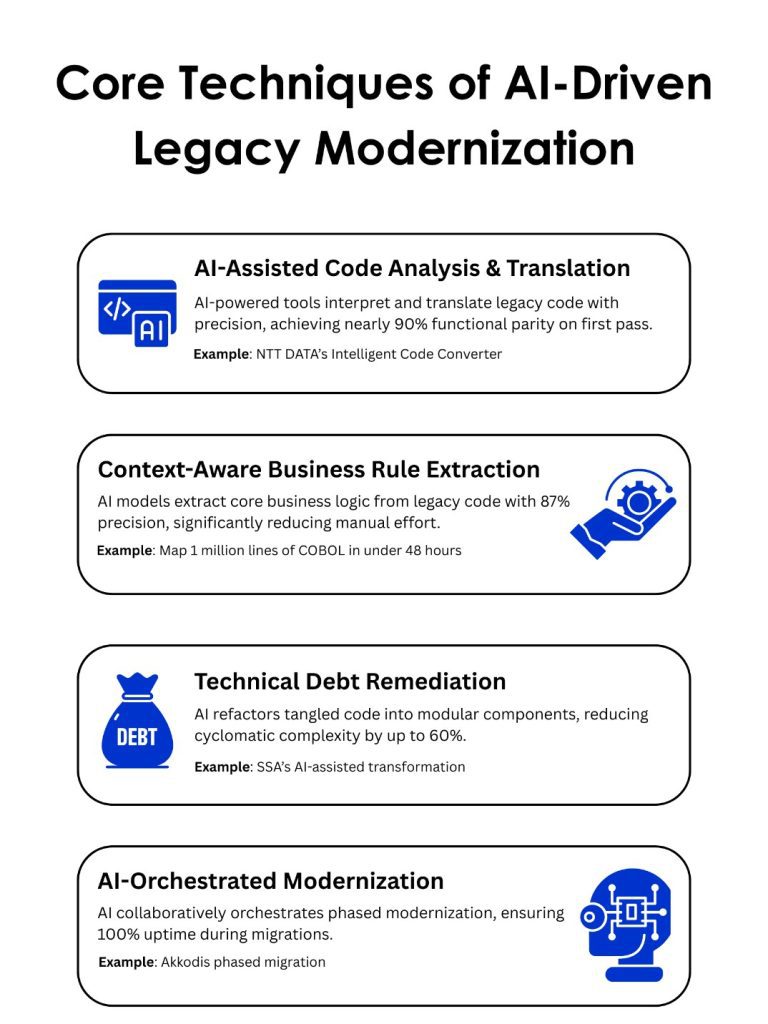
1. AI-Assisted Code Analysis & Translation
Today’s AI-powered code analysis tools are capable of interpreting and translating legacy programming languages like COBOL, RPG, or Delphi into modern languages such as Java or C# with remarkably high precision, often achieving accuracy rates above 89%. This is leagues ahead of older rule-based systems, which struggled with ambiguous logic and required heavy manual intervention.
Example: NTT DATA’s Intelligent Code Converter
Converted 500,000 lines of RPG to Java in just 72 hours, with nearly 90% functional parity on the first pass.
2. Context-Aware Business Rule Extraction
Today’s transformer-based models can understand code the way humans do—by recognizing patterns, dependencies, and intent.
With access to 14 million code repositories, AI can now:
- AI models extract core business logic from legacy code with 87% precision, significantly reducing manual effort.
- Map 1 million lines of COBOL in under 48 hours
- Surface 92% of embedded business rules automatically
3. Technical Debt Remediation with Reinforcement Learning
Instead of rewriting tangled code from scratch, AI can refactor it into modular components, reducing cyclomatic complexity by up to 60%.
Example: SSA’s AI-assisted transformation
The U.S. Social Security Administration reported saving $2.3 million annually by leveraging AI to restructure key legacy modules into maintainable units, eliminating the need for a complete rewrite.
4. Incremental Modernization via AI Orchestration
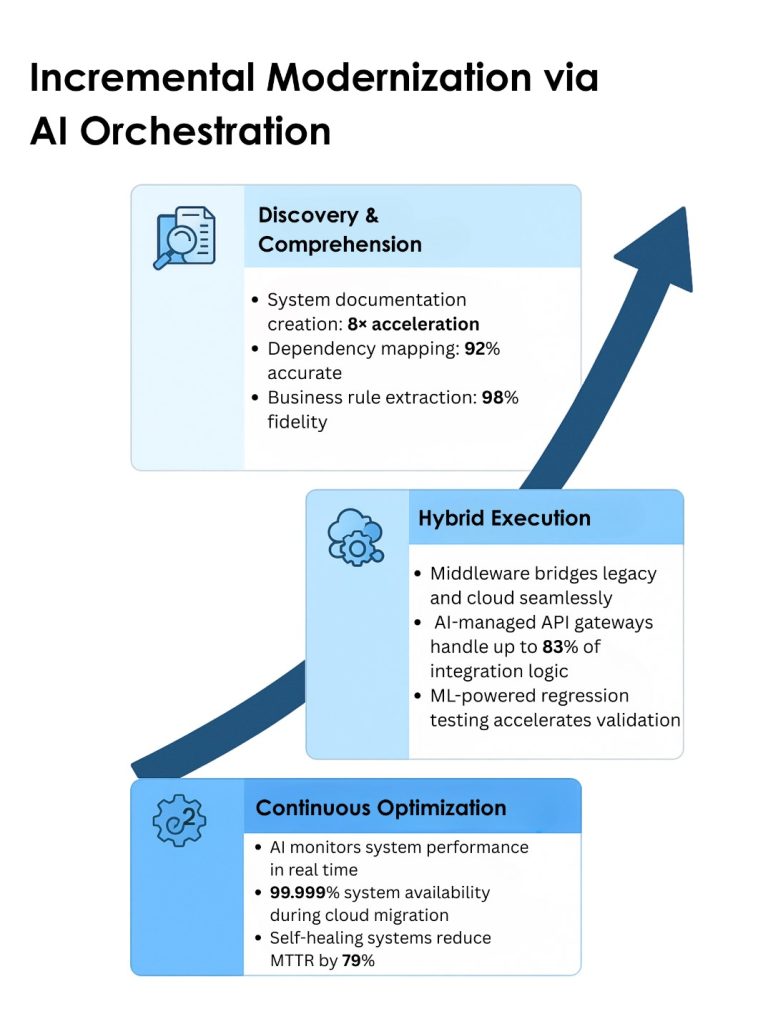
Phase 1: Discovery & Comprehension
- System documentation creation: 8x acceleration through AI-generated outputs
- Dependency mapping: 92% accurate
- Business rule extraction: 98% fidelity
Example: Thoughtworks’ reconstitution engine
Reduced discovery time from 9 months to 11 weeks for a major European bank.
Phase 2: Hybrid Execution
- Middleware bridges legacy and cloud seamlessly
- AI-managed API gateways handle up to 83% of integration logic
- ML-powered regression testing accelerates validation
Example: Akkodis phased migration
Migrated 142 modules in 18 months with 100% uptime for an automotive dealer network.
Phase 3: Continuous Optimization
- AI monitors system performance in real time
- Predictive maintenance flags issues before failures
- Self-healing capabilities reduce MTTR by 79%
Example: South Carolina Health Department
Achieved 99.999% system availability during cloud migration using AI-powered validation frameworks.
Best Practices to Implement the Middle Path
Strategic Prioritization Using the AI Impact Matrix
| Criteria | Weight |
| Business Criticality | 40% |
| Technical Debt Severity | 30% |
| Complexity to Modernize | 20% |
| ROI Potential | 10% |
Use Case: Tier 1 Bank
Applied the matrix and identified 68 high-impact components, delivering $14M in annual savings.
Risk Mitigation: Don’t Modernize Blindly
- AI-powered impact analysis forecasts dependency issues with 89% accuracy
- Hybrid test environments allow parallel runs and simulated regressions
- Continuous knowledge capture keeps system documentation current during transformation
Lesson: Think evolution, not explosion.
The Softura Advantage: Cognitive Modernization in Action
At Softura, we don’t just follow the middle path, we paved it.
Our Cognitive Modernization Platform (CMP) delivers AI-driven modernization at enterprise scale, anchored on three strategic pillars:
1. Legacy Comprehension Engine
- Processes 2M lines/hour across 48 languages
- Generates interactive maps with 95%+ accuracy
- Cuts discovery phase costs by 65%
2. Adaptive Transformation Framework
- Converts legacy logic into cloud-native code with 87% automation
- Ensures 100% compliance via embedded governance rules
- Deploys 73% faster than traditional rebuilds
3. Intelligent Operations Hub
- Predicts system anomalies with 92% precision
- Automates 83% of post-migration tasks
- Reduces Mean Time to Repair (MTTR) by 79%
Client Success Story: Global Insurance Leader
Modernized 18 legacy systems in 24 months, achieving:
- $28M cost savings
- 99.97% uptime
- 142% ROI in 18 months
The Future of Application Modernization Is Hybrid, AI-Driven, and Human-Led
Legacy modernization used to mean “rip and replace.” But modern enterprises know better. The future lies in adaptive evolution, where AI assists human teams in gradually transforming the old into something sustainable, scalable, and intelligent.
By 2027, Gartner estimates that 65% of enterprise modernization initiatives will use AI-assisted approaches, compared to just 22% in 2024.
Why?
- 3–5x faster time-to-value
- Up to 80% cost savings
- Lower risk than full rebuilds
The next frontier is self-modifying systems, where AI autonomously improves code through reinforcement learning. Early pilots show 40% autonomous optimization.
Final Thought: Break the Dilemma, Not the System
Legacy systems aren’t the enemy. Inflexibility is.
You don’t have to choose between expensive rebuilds or expensive stagnation. The AI-powered middle path lets you:
- Preserve what works
- Modernize what doesn’t
- Scale intelligently and affordably
At Softura, we help organizations like yours unlock transformation—not by starting over, but by moving forward with what you already have.
Let’s take the smarter path. Together.
Interested in AI-Driven Modernization?
Explore how forward-thinking enterprises are using AI-powered frameworks to modernize legacy systems without disruption. Want access to our AI Impact Matrix template or learn more about phased modernization techniques? Reach out to our editorial team to start the conversation.

Right Firms
23 May 2025


Latest Posts





Submit Your Inquiry
Related Posts
Dec 2025
How AI and Automation Are Shaping Outsourcing in 2026 and What Buyers Should Know
If you look at the outsourcing world right now, it feels like someone has quietly moved the furniture around. Nothing is exactly where it used to be. A few years ago, companies chose vendors based on headcount, location, pricing and maybe a portfolio that looked convincing enough. In 2026, the whole selection process feels different because AI has slipped into almost every part of the workflow. The way agencies operate is changing, and the way buyers judge those agencies is changing too. Everything from project planning to delivery timelines is now influenced by automation. Even the roles you hire for look different. Businesses that never imagined they would need ChatGPT developers or OpenAI developers now see those skills as essential for staying competitive. So what does this shift really mean for companies looking to outsource this year? AI is no longer something “extra”. It has become the first step of most projects. A strange thing has happened in outsourcing. Before a task ever reaches a designer or developer, it often goes through an AI tool first. This can be as simple as sorting information or as complex as generating the first draft of a workflow. Many teams use agentic AI to break down tasks, draft requirements, analyse bugs or test scenarios. It is not replacing humans, but it is clearing the clutter so people can focus on the parts that actually need human thinking. For buyers, this means something important. If a vendor shows real capability in automation, you can expect a smoother project. If they do not, you often end up paying for hours that could have been avoided. This is why agencies with dedicated ChatGPT developers or engineers comfortable with OpenAI’s newer toolchains are in higher demand. They know how to make AI work without slowing everything down. Buyers now evaluate “AI maturity” the same way they once judged portfolios It used to be simple. You looked at case studies, maybe asked for a few references, and compared pricing. Now companies also try to understand how deeply an agency actually uses AI in its daily work. A lot of agencies talk about AI. Far fewer truly integrate it. In a typical evaluation today, buyers ask things like: Do they have proven internal automation systems Which parts of their coding or testing are supported by AI Are their OpenAI developers experienced with real projects or only hobby-level experimentation Can they explain how AI improves quality and speed without overselling it This level of questioning was rare in 2021. Now it feels normal. Teams look different in 2026 One thing that stands out when you observe modern outsourcing teams is the shift in how work is divided. There is usually a human lead, but the supporting structure is partly automated. A developer might have an AI assistant completing small code suggestions.A project manager might use automation to monitor progress, create summaries, or send reminders.A designer might explore early concepts using AI before refining everything by hand. This blend feels natural now, but it took a while for people to trust it. Buyers should not focus only on who is on the team; they should also ask how the work actually flows. There are agencies who treat AI like a fancy gadget, used only for marketing. Then there are those who have built their processes around it, quietly improving productivity without making a big announcement. Those are the teams worth watching. The definition of “qualified talent” has changed Being a good developer is not enough anymore. The market now expects people who can work comfortably with AI-driven environments. If you are outsourcing software development, you might notice that job titles have evolved. It is common to see: conversational AI engineers automation specialists ChatGPT developers OpenAI developers who understand fine-tuning, embeddings and tool-calling logic hybrid designers who work across traditional and AI-powered workflows It does not mean old skills are outdated. It means buyers want teams who can combine traditional engineering with AI fluency. When an agency understands both worlds, projects move faster and require less rework. Deliverables have changed because automation speeds things up This is one of the biggest shifts. AI has made early drafts incredibly fast to produce. Wireframes, data models, user journeys, and even sample code often appear earlier in the project than they used to. But speed introduces its own challenges. Faster does not always mean better. Sometimes AI-generated materials look polished at first glance, but they need careful human review to avoid mistakes. Good agencies understand this balance. They use AI for acceleration but rely on real expertise for polish and decision-making. If you are evaluating vendors, ask them how they maintain quality while moving faster. You will quickly notice which teams have figured it out and which teams are guessing. Risk management looks different in the AI era Buyers used to worry about cost overruns, late delivery or communication gaps. Now there is a new category of questions. People want to know: How does the agency handle data if AI tools are involved Which tasks are automated and which are still manual How they review the output of agentic AI systems Whether they understand the risks of relying too heavily on automated decisions These questions matter because automation can multiply errors very quickly if it is not monitored properly. The safest agencies are the ones who treat AI as a powerful tool but still maintain human checkpoints. Agencies must guide clients, not just execute A noticeable shift in 2026 is the advisory role that agencies now play. Many buyers know they want to use AI, but they are not entirely sure how. They come with enthusiasm, but also many assumptions that need clarification. A strong partner will help you understand: what AI can realistically do for your project what should remain in human hands how to build hybrid workflows how to budget for AI features what long-term maintenance actually looks like When an agency can educate as well as execute, trust builds faster. How RightFirms fits into this changing landscape With so many agencies claiming AI expertise, buyers need a way to filter the ones who truly understand it from the ones who are simply relabelling old work. RightFirms helps solve that by allowing companies to search for partners based on real capabilities in areas like ChatGPT development, OpenAI model integration and modern agentic AI systems. Instead of hoping you find the right fit, you can shortlist vendors who already demonstrate the skills and maturity needed for 2026-level outsourcing. Final Thoughts Outsourcing in 2026 feels familiar in some ways and completely new in others. The fundamentals remain steady: clear communication, reliable delivery, steady collaboration. But the tools have changed. The expectations have changed. The talent landscape has changed. AI is now part of the workflow whether companies plan for it or not. The best thing buyers can do is choose partners who understand AI at a practical, grounded level. Not hype, but usable skill. Not theory, but real output. Whether you need automation help, application development or a full AI-driven product, the right agency will use both technology and human judgement to deliver outcomes you can trust.

Nov 2025
Applied Computing in the Age of AI: Preparing for the Next Wave of Intelligent Systems
Artificial intelligence is rapidly reshaping industries across the board, and software is high on that list. AI is changing how software is designed, deployed, and maintained, but those transformations don't happen in a vacuum. Behind every major breakthrough in AI, there's a solid foundation in applied computing. As demand for AI and intelligent technology grows, software engineers and IT professionals aren't going to vanish -- but they will have to master the underlying principles that allow these systems to perform securely and ethically. So what can you do to prepare your skillset for the coming wave of intelligent systems? Understanding Applied Computing in the AI Era First, let's talk about applied computing and what it means in the age of AI. Applied computing bridges the gap between theoretical computer science and practical application. Rather than being an abstract theory of computing, applied computing focuses on solving real-world problems through computational design and modeling. What does that mean in the context of AI? It means applied computing is what forms the framework that makes those advanced technologies usable, scalable, and intelligent. All AI systems rely on core principles of applied computing, such as: Algorithm design (creating efficient ways for machines to process data) Data architecture (organizing and structuring massive datasets) Human-machine interaction (making sure the AI aligns with ethical guidelines and user needs) Systems integration (putting hardware, software, and data systems together seamlessly) In short, applied computing isn't just about writing code -- it's interdisciplinary, requiring advanced engineering of intelligent computing ecosystems. Will AI Make Coding Obsolete? A common fear across any number of fields is whether or not AI will make one's job obsolete -- and in the short term, those fears have been shown to be somewhat justified. There's a misconception that AI tools such as GitHub Copilot or ChatGPT will entirely replace programmers, or that "vibe coding" will supplant skilled coders. While these tools can accelerate productivity through automation, AI is not going to make coding obsolete -- although it may redefine what coding means. As of this writing, AI can generate snippets of code, but it can't replicate the conceptual work of a human skilled in applied computing. An applied coding professional can design robust algorithms, integrate multiple systems to ensure interoperability, validate AI-generated output for accuracy, and identify any ethical flaws, security vulnerabilities, or data biases in automated systems. These are all things no intelligent system can do at present, and may never be able to. This means that while AI might handle some parts of the software creation process, humans remain essential when it comes to designing the architecture, conducting oversight, and making decisions based on context and evidence. Preparing for the Coming Wave This new way of approaching software and coding means developing some new skillsets as the boundary between AI, software engineering, and systems design begins to blur. Continuous learning will become a practical necessity. So what kind of skills should software engineers be ready to develop? Engineers should be prepared to master algorithm optimization, so they can refine algorithms for maximum scalability and sustainability. This means mastering the fundamentals of machine learning and mathematical modeling. They should also know about distributed computing, as most modern AI systems make extensive use of distributed architectures such as cloud environments. It's also important to know about real-time data processing, as IoT devices rely heavily on a constant stream of data. Finally, it's crucial to understand the ethical principles behind responsible applied computing, whether it's weeding out bias, ensuring data security, or maintaining an ethical AI framework. Upskilling for the Future There are several ways one could prepare for these upcoming changes, including: Working on research projects with open-source AI or cloud computing initiatives to gain some real-world experience; Pursuing credentials in cloud platforms (AWS, Azure), Python-based data analysis, or machine learning; Enrolling in a formal program such as an applied computer science degree, which blends computing theory with AI, data analytics, and system design. Pursuing a degree online means you can continue your career as you study and implement new skills as you learn them. The Human Side of AI and the Future of Applied Computing As AI continues to evolve, it's important to remember one thing: that the technology is only successful so long as it effectively serves human goals. AI is no good in a vacuum. Applied computing professionals will play an important role in making sure intelligent systems are transparent, ethical, and inclusive. At the same time, however, AI is going to become less and less of a separate field as time goes on, and become more of an integrated layer of every digital system. Whether it's predictive healthcare analytics or adaptive cybersecurity frameworks, AI will continue to play a role -- and applied computing along with it.

Sep 2025
Offshoring for AI App Development: Why It’s Booming Among U.S. Companies
AI has become less of a question of ‘if’ and more of ‘how fast,’ as U.S. enterprises embed it into their core functions. Healthcare systems are deploying predictive analytics for earlier and more accurate diagnoses, financial institutions are strengthening fraud detection through machine learning, and retailers are reshaping customer engagement with AI-driven personalization. McKinsey reports that more than half of U.S. companies now use AI in at least one business function, and adoption continues to accelerate across sectors. Yet this momentum comes with a constraint: the supply of skilled professionals is not keeping pace. The World Economic Forum projects a shortfall of more than one million AI specialists by 2030, while senior engineers in the U.S. already command salaries above $300,000 annually. This imbalance between ambition and capability has created structural bottlenecks, forcing executives to reconsider conventional hiring strategies and turn toward global talent partnerships as a pathway to scale. Source: World Economic Forum, Future of Jobs Report (Talent Gap Projection, 2023–2030) Why Global AI Teams Are Becoming Strategic Offshore development has matured from a cost-saving exercise into a strategic enabler of innovation. Companies like Microsoft and Tesla exemplify this shift. Microsoft continues to expand its AI programs through global partnerships while maintaining strategic oversight domestically. Tesla leverages distributed teams for autonomous vehicle development, combining in-house innovation with international expertise to drive innovation. The rationale is clear: offshore partnerships provide access to scarce talent, accelerate time-to-market, and deliver specialized capabilities. Round-the-clock development cycles shorten delivery timelines, while niche skills in generative AI, natural language processing, and predictive analytics are often more accessible offshore than in U.S. markets. The Core Benefits Executives highlight three advantages that make offshore AI partnerships increasingly attractive: access to global talent, accelerated development, and operational flexibility. 1. Access to Global TalentCountries such as India and Poland are producing highly skilled engineers at scale. India graduates more than 200,000 engineers annually with specialization in AI and data science, while Poland hosts over 250 AI firms with strong expertise in computer vision and NLP. Offshore partnerships give companies immediate access to talent pools that would take years to cultivate domestically. 2. Accelerated Development VelocitySpeed defines competitive advantage in AI. Offshore teams enable continuous progress across time zones, compressing development cycles significantly. A Fortune 500 financial services company, for example, brought a fraud detection solution to market two months ahead of schedule by leveraging offshore AI specialists, a window that proved decisive in a competitive segment. 3. Operational Flexibility AI projects rarely require fixed resources. Early prototyping demands small, specialized teams, while large-scale deployments call for broader engineering groups. Offshore models allow companies to scale resources up or down seamlessly, aligning investment with project needs rather than permanent headcount. Managing Risks Through Structure Concerns about data security, compliance, and collaboration are common but increasingly manageable with the right frameworks. Leading offshore providers operate within GDPR, HIPAA, and SOC 2 standards as a baseline. Secure environments, end-to-end encryption, and robust IP agreements ensure sensitive datasets remain protected. Effective communication frameworks are equally important. Hybrid sprint models, structured overlap hours, and transparent documentation help teams maintain alignment despite geographic distribution. Cultural integration strategies, from orientation programs to shared communication protocols, transform potential friction into operational rhythm. In one healthcare case, offshore collaboration enabled a predictive analytics platform to be developed within strict HIPAA guidelines. Strong governance, secure architectures, and clear accountability allowed innovation without regulatory compromise. Market Dynamics and Future Outlook The offshore AI development market is forecast to grow at a 25% compound annual rate between 2025 and 2030. This trajectory reflects a broader recognition: AI is not a generalist function but a highly specialized discipline requiring distributed expertise. Enterprises are moving toward long-term alliances with offshore providers who understand not only technical requirements but also industry regulations and business goals. Edge AI, multimodal systems, and quantum machine learning demand skills rarely concentrated in one market. Accessing global talent is becoming essential for staying competitive. Strategic Considerations for Executives For business leaders evaluating offshore AI development, four factors are critical. Partner selection should prioritize proven expertise, compliance credentials, and operational maturity. Governance structures must define clear decision rights, communication channels, and escalation protocols. Integration planning is essential — investing in onboarding, knowledge transfer, and relationship building avoids misalignment. Risk management should cover IP protection, security audits, and contingency planning to ensure resilience. The Competitive Imperative The AI talent gap shows no sign of easing before 2027, meaning competition for scarce domestic resources will remain intense. Meanwhile, the global AI market is projected to grow from $251.7 billion this year to $338.9 billion next year — a 34.7% surge. Companies unable to move at speed risk falling behind as markets consolidate around faster, more agile competitors. Forward-looking executives increasingly recognize offshore AI partnerships not as tactical stopgaps but as strategic accelerators. These partnerships deliver the talent, velocity, and flexibility required to lead in a field where innovation cycles are measured in months, not years. Conclusion In my experience working with global enterprises, the organizations that succeed with AI are those that treat offshore partnerships as a strategic capability rather than a cost lever. The ability to access specialized expertise, scale teams with precision, and maintain development momentum across time zones often determines whether initiatives move from pilot to impact. What I see across industries is clear: companies that invest early in building trusted global alliances are better positioned to turn ambition into execution. AI innovation depends not only on technology but also on the strength of the ecosystems we build around it. The leaders who recognize this and act decisively will shape the next decade of AI-driven growth.