


Which Industries Are Investing the Most in AI Development? 2026 Market Analysis
10 Aug 2026 | Right Firms
Global enterprise AI spending hit $407 billion in 2026, up 34.8% from $302 billion the year before. That headline number gets repeated everywhere, but it hides the more useful story: this spending is wildly uneven across industries. Some sectors are running AI in production at massive scale. Others are still stuck in pilot programs three years into the AI adoption cycle.
This report breaks down where AI investment is actually concentrated in 2026, what those industries are building, how project sizes compare, and which technologies are driving the demand behind the numbers.
The 2026 AI Spending Picture, by the Numbers
At the macro level, AI investment is accelerating across nearly every category of enterprise technology spending. Gartner’s 2026 forecast puts total worldwide AI spending (including hyperscaler infrastructure, chips, and consumer products) at $2.59 trillion, a 47% jump from 2025. Enterprise IT budgets now allocate an average of 18% to AI, up from just 11% in 2024, with technology-forward sectors like financial services and SaaS pushing that figure to 25 to 30%.
The enterprise-only slice of that spending, the $407 billion figure most relevant to businesses planning their own AI investment, breaks down clearly by sector.
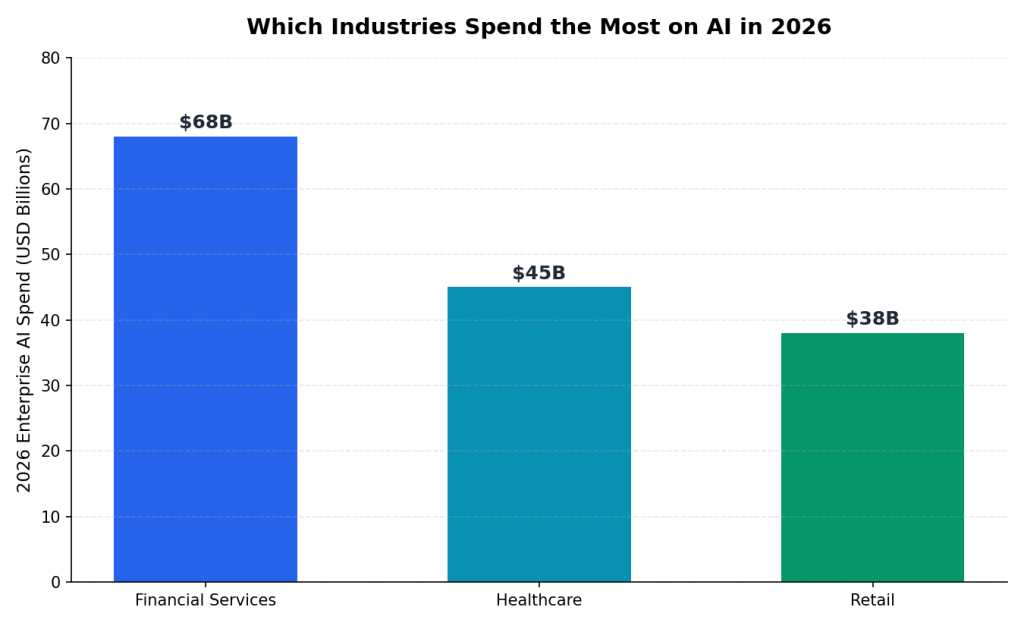
Financial services leads by a wide margin at roughly $68 billion, followed by healthcare at $45 billion and retail at $38 billion. But dollar totals only tell half the story, because they are also a function of how large and how digitized an industry already was before AI adoption began.
Spend vs. Adoption: Two Different Rankings
The industry spending the most money on AI is not the industry using it most widely. Adoption rate, the share of companies in a sector running AI in some production capacity, tells a different and arguably more useful story for benchmarking your own business against your industry.
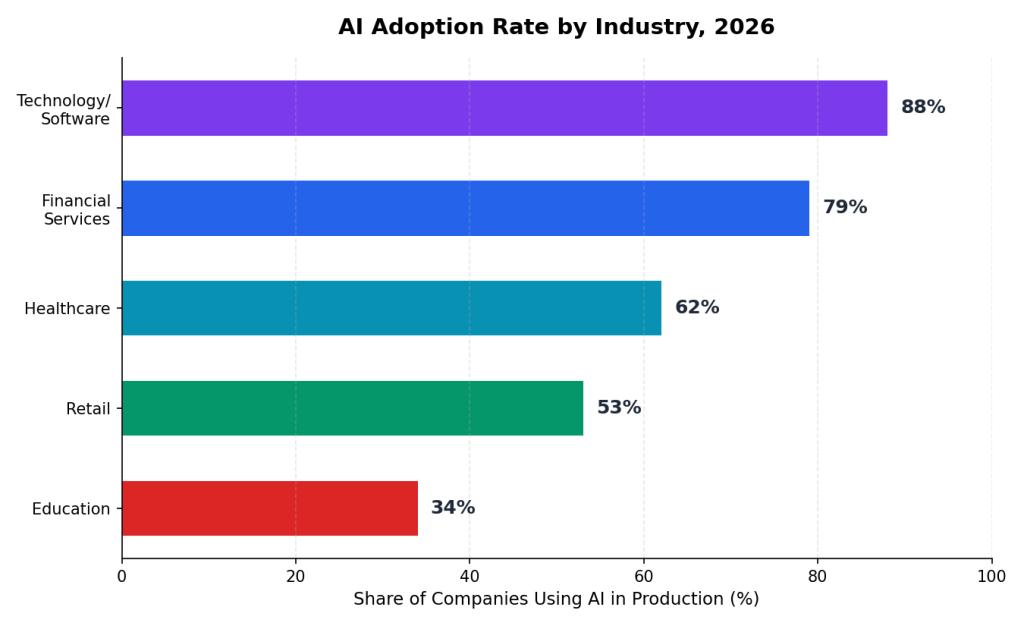
Technology and software companies lead adoption at 88%, ahead of financial services at 79%, healthcare at 62%, retail at 53%, and education trailing every other major sector at just 34%. The gap makes sense once you separate the two dynamics at play: financial services outspends everyone because it is replacing decades-old fraud, trading, and servicing infrastructure at enterprise scale, while software companies show the highest adoption simply because AI tooling is native to how they already build product, so the cost of adopting it is lower than it is for a hospital system or a school district.
What Each Leading Industry Is Actually Building
The investment totals only matter in context of what the money is funding. Here is what is actually being built inside the industries driving 2026 AI spending.
Financial services is concentrated in three areas: fraud and anti-money-laundering detection, algorithmic and quantitative trading systems, and customer-facing service automation that is replacing a real share of first-line call center volume. This is not experimental spend. A large majority of financial and insurance firms, roughly 85%, plan to increase AI budgets further over the next year, and the median annual AI budget at an enterprise-sized financial firm now sits above $2 million, with the largest banks spending far beyond that median.
Healthcare’s $45 billion is anchored heavily in diagnostic imaging, where AI models are now reaching accuracy levels that match or exceed radiologist performance on narrow, well-defined tasks like tumor detection in mammograms and CT scans. That measurable clinical accuracy is what is pushing adoption past 60% despite healthcare’s typically slow procurement cycles and heavier regulatory review than almost any other sector on this list.
Retail investment centers on demand forecasting and personalization, with AI-driven recommendation engines reported to lift average order value by roughly 12%. This is one of the clearest ROI stories in enterprise AI right now, which explains why retail adoption is climbing even though the sector’s total dollar spend is smaller than finance or healthcare.
Manufacturing does not crack the top three in absolute 2026 spend, but its year-over-year growth rate, around 48%, is the fastest of any sector tracked. That growth is concentrated in predictive maintenance and computer-vision quality control on production lines, both use cases with an easy-to-measure ROI metric (fewer unplanned line stoppages, fewer defective units shipped) that tends to accelerate adoption once a handful of reference projects prove the math.
Education, at just 34% adoption, remains the clear laggard, held back by tighter budgets, slower procurement, and data privacy constraints around student information. Where education AI investment is happening, it concentrates narrowly around tutoring support and administrative automation rather than broader institutional deployment.
Average Project Sizes: What This Looks Like at the Company Level
Enterprise-wide totals can make AI investment sound like it only applies to Fortune 500 budgets. In practice, project sizes vary enormously by company size and industry maturity, but a few patterns hold across the data:
- Financial services and healthcare projects tend to be the largest individually, often reflecting multi-year platform builds (fraud detection systems, diagnostic imaging tools) rather than single-feature additions, consistent with the median $2 million-plus annual AI budget reported among enterprise financial firms.
- Retail and manufacturing projects more often start narrower and scale after an initial proof of concept validates the ROI metric (order value lift, defect reduction), which tracks with the faster year-over-year growth rate seen in both sectors.
- Mid-market businesses across all industries are increasingly funding smaller, use-case-specific AI projects rather than broad platform initiatives, a pattern that shows up clearly in inquiry activity across RightFirms’ own AI development directory, where scoped projects (a specific chatbot, a specific forecasting tool, a specific automation workflow) now outnumber requests for open-ended “AI transformation” engagements.
The Technology Driving 2026 Demand: AI Agents
Inside nearly every industry’s AI budget, the fastest-growing line item is no longer basic chatbots or copilots. It is AI agents capable of executing multi-step workflows with less human review at each step. Gartner forecasts AI agent software spending will reach $206.5 billion in 2026 and climb to $376.3 billion in 2027, close to 82% growth in a single year, a far steeper curve than the 34.8% growth rate for enterprise AI spending overall.
This shift matters for how businesses should read their own industry’s position in the data above. A sector showing modest 2026 spend growth may still be close to an inflection point once it moves from single-purpose AI tools toward agentic workflows, the same transition financial services made over the past two years moving from basic fraud-scoring models to more autonomous trading and servicing agents.
What This Means for Businesses Planning AI Investment
Three practical takeaways follow directly from this data, regardless of which industry you operate in:
- A low current adoption rate is not a reason to wait. Manufacturing and retail are proving that industries starting from a smaller base can post the fastest growth once one credible, ROI-backed project exists internally to justify the next one.
- Governance and security budgets are growing faster than deployment budgets. Governance now claims 8 to 12% of the average enterprise AI budget, up from just 3 to 5% in 2024, a signal that businesses further along in AI adoption are shifting spend toward controlling and auditing what they have already built, not just building more.
- Scoped, single-use-case projects are outperforming broad transformation initiatives. Across nearly every industry in this data, the clearest ROI stories (retail’s 12% order value lift, manufacturing’s defect reduction, healthcare’s diagnostic accuracy) came from narrow, measurable use cases rather than open-ended AI strategy engagements.
Where to Go Next
If your industry shows lower current adoption in this report, that is not a signal to deprioritize AI investment, it is a signal to start with a narrow, measurable use case rather than a broad initiative, the same pattern driving growth in manufacturing and retail. RightFirms’ AI development company directory lets you compare vendors by industry experience and project focus, and the AI-powered recommendation tool can match your specific use case against verified partners with relevant sector experience.
The industries winning the AI investment race in 2026 are not necessarily the ones spending the most. They are the ones that found one measurable use case, proved the ROI, and used that proof to justify the next budget increase. That pattern is available to any business, in any industry, regardless of where it currently sits in this report’s rankings.

Right Firms
10 Aug 2026


Latest Posts




Submit Your Inquiry
Related Posts

Aug 2026
How Can Teams Build More Effective GUI Test Automation Processes?
Most teams don't fail at GUI test automation because they picked the wrong framework. They fail because they built a process that looked solid on paper but fell apart the moment the UI changed, and that happens far more often than anyone wants to admit. If you've ever watched a test suite flip from green to red overnight because someone updated a button label, you know exactly what this feels like. Faster test runs are great, but the real goal is a process your team can trust, maintain, and scale without a constant fire drill. That means rethinking how you select tools, design test cases, and organize the work itself. The teams that get this right share a handful of common habits; none of those habits are mysterious. They're repeatable, learnable, and worth building in from day one. Choosing the Right Tools and Structuring the Work Your tool choice determines how much of the team's time goes toward writing tests versus fixing them. GUI test automation tools listed by Functionize cover a wide range, from script-based frameworks to platforms that adapt to UI changes automatically, so match that selection to your team's actual skill mix and maintenance capacity rather than defaulting to whatever gets the most conference mentions. A framework requiring deep coding fluency is a liability when most of your team are manual testers. A no-code tool, on the other hand, might be too rigid for teams that need granular control over complex workflows. Start by mapping your current stack. What tech is the front end built on, how frequently does the UI change, and how much time do you realistically have for test maintenance each cycle? Those three questions narrow the field fast. And don't treat tool selection as a one-time decision; plan a re-evaluation checkpoint every 12 months so you can catch cases where the tool has quietly become a bottleneck rather than an accelerator. Match the Framework to Your Release Cadence Teams shipping on tight weekly or biweekly schedules need automation that keeps pace without breaking constantly. That means prioritizing self-healing capabilities, strong locator strategies, and solid parallel execution support. If your releases are slower and more deliberate, a script-heavy approach might work fine because your team has room to maintain it properly. But here's the thing: many teams badly underestimate how fast their cadence picks up once CI/CD pipelines mature. So build for where you'll be in six months, not just where you are right now. Align Tool Evaluation with Team Skill Sets You can have the best framework on the market and still get poor results if your team can't use it confidently. Bring QA engineers, developers, and even product managers into the evaluation. Run a short proof of concept on three to four real test cases from your backlog and see which tool produces the least friction. Measure setup time, test creation time, and how long it takes to debug a failure. Those numbers tell you far more than a feature checklist ever will. Designing Test Cases That Don't Break Every Week Good test design is where most teams have the widest gap between what they know they should do and what they actually do under deadline pressure. The result is a suite packed with brittle tests demanding constant attention. Effective GUI test automation processes treat test case design as a first-class activity, not an afterthought. Start with a clear scope: automate the high-value, high-stability user flows first, and leave edge cases to manual testing until your suite is in good shape. A focused, stable set of 50 tests delivers more value than 300 tests where 40% are flaky. Think about the paths your users take most often, and the ones where a failure would be immediately visible to customers. Those are your automation targets. Everything else can wait. You should also write test cases with change in mind from the beginning, because the UI will change, and your tests need to survive that without a full rewrite every time. Use Page Object Models to Isolate UI Changes The Page Object Model (POM) is one of the most effective patterns for keeping test suites maintainable over time. Each screen or component in your application gets its own object that holds the locators and interactions for that area of the UI; test scripts then call those objects rather than hardcoding selectors directly into every test. So when a button moves or a class name changes, you update one file rather than fifty. Teams that skip this step in the interest of speed usually pay for it within two or three sprints, when a single UI redesign eats up days of rework across the test suite. POM adoption doesn't require a big-bang refactor. You can introduce it incrementally, starting with the screens that change most often, and work outward from there. Prioritize Stable Selectors Over Brittle Ones Your tests are only as stable as the locators they depend on. CSS classes auto-generated by UI frameworks, text content that shifts with A/B tests, position-based selectors, all of these are failure points waiting to surface. The better path is working with your development team to add dedicated test IDs (attributes added specifically for automation purposes) to the elements your tests interact with. This takes a small upfront investment; the payoff over time is outsized. Test IDs don't change with style refactors or layout shifts, and they're an explicit signal to any developer who encounters them that an automated test depends on that element, which makes accidental breakage far less common. Keeping the Process Healthy Over Time Building a solid GUI test automation process is one challenge. Keeping it healthy six months later is a different one entirely. Flaky tests accumulate, coverage drifts from the actual application, and documentation goes stale. Teams that stay ahead of this treat test maintenance as a recurring part of each cycle rather than a separate cleanup project that never quite makes it onto the schedule. A useful rule of thumb: allocate around 10 to 15 percent of each cycle's capacity to test health, quarantining flaky tests, updating selectors, and retiring tests for features that no longer exist. Track your suite's pass rate over time, too. A pass rate trending downward is a warning sign, and catching it early is far less painful than running a full audit after things have gone sideways. Build in a monthly review where the team looks at failure patterns together and identifies whether those failures point to real bugs or to test infrastructure problems that need attention. Treat Flaky Tests as Technical Debt A flaky test, one that passes sometimes and fails other times without any code change, is worse than no test at all. It trains your team to ignore red builds, which means real failures get buried in the noise. Honestly, the right response is to quarantine any flaky test the moment you identify it. Move it out of the main suite, open a ticket to investigate the root cause, and don't let it back in until it passes 20 or more consecutive runs without failing. That might sound strict, but it protects the credibility of your entire suite. Conclusion More effective GUI test automation processes aren't built in a single cycle. They come from consistent decisions: matching tools to your team's real capabilities, designing tests that survive change, and treating maintenance as ongoing work rather than a deferred cleanup task. Start with a focused set of high-value test cases, apply patterns like the Page Object Model early, and give your team the space to keep the suite healthy over time. That combination doesn't just cut down on failures; it builds a process your team can actually trust.

Jul 2026
The 2026 Technology Hiring Report: Which Development Services Are Growing Fastest?
Every year brings a fresh batch of "top tech trends" predictions, most of them written before the year's actual hiring and spending data exists. This report takes a different approach. Rather than guessing where the industry is headed, it pulls together verified 2026 labor market data, enterprise technology spending reports, and hiring activity patterns across RightFirms' own directory of 30,000+ verified software and IT companies to show where demand is actually concentrating right now. The short version: AI-adjacent roles are growing the fastest by a wide margin, cybersecurity is close behind, cloud and data engineering remain steady anchors, and low-code development is quietly becoming one of the more resilient hiring categories of the year. What is different in 2026 compared to prior years is not that AI is growing (that story is not new) but that the growth has moved from experimentation budgets into permanent headcount and vendor contracts. Methodology This report combines three sources: published 2026 labor market data from firms tracking job postings and salary trends, enterprise technology spending research, and observed hiring and inquiry patterns across RightFirms' software development and AI development directories, where businesses actively search for and vet vendors. Where a specific statistic is cited, the original source is named so readers can verify it directly rather than take a report's word for it. 1. AI and Machine Learning: The Clear Fastest-Growing Category AI-related hiring is not a marginal trend anymore, it is the dominant one. Robert Half's 2026 technology hiring research found AI, ML, and data science job postings climbing sharply year over year, with AI integration ranked among the initiatives most affected by ongoing skills shortages. Separate industry tracking found the share of AI and ML roles within overall tech job postings rising dramatically over the past two years, and workforce researchers have identified AI-related positions among the fastest-growing categories across the entire ICT sector. For businesses, this shows up less as "we hired one AI engineer" and more as a structural shift: AI proficiency is increasingly expected as a baseline skill across software engineering roles, not a specialty bolted onto a separate team. This is also reflected directly in directory activity, where AI development and AI consulting inquiries have become one of the most searched categories on RightFirms over the past year, alongside more established categories like custom software and mobile app development. 2. Cybersecurity: Growing Almost as Fast, for Different Reasons Security hiring has kept pace with AI growth throughout 2026, driven by two forces at once: escalating threat activity and the new attack surface created by AI adoption itself. Reporting on 2026 technology hiring found security-related postings up sharply year over year, with cybersecurity engineers alone accounting for a large share of new listings. Tech leaders surveyed for the same research named security among the top initiatives delayed or derailed by skills shortages, second only to AI integration. The practical takeaway for enterprise technology planning: security is no longer a line item added after a product ships. Businesses building AI features, cloud migrations, or customer-facing platforms are increasingly bringing in dedicated security expertise from the start of a project, not after a launch. 3. Cloud Development: Steady, Not Explosive, But Foundational Cloud computing continues to be one of the most consistently growing categories in enterprise technology, even if it lacks the dramatic year-over-year percentage jumps AI is posting. Industry hiring statistics place cloud computing among the fastest-growing tech sub-sectors by job growth rate, and cloud architecture remains a top hiring priority named by business leaders in multiple 2026 surveys, alongside IT operations and infrastructure work. What has changed is the nature of cloud development requests. Businesses are less often asking "should we move to the cloud" (that decision was largely made years ago) and more often asking for multi-cloud strategy, cost optimization, and cloud-native application architecture. This maturing of the request itself is a trend worth noting for any business currently vetting cloud development companies. 4. Data Engineering: The Infrastructure Behind Every AI Initiative Every AI project depends on a data pipeline that most companies underestimate until they are already mid-project. That dependency is now visible in hiring data. Data engineer roles rank among the highest-demand technology positions for 2026, with strong salary growth reported alongside AI/ML and cybersecurity roles, and data engineering has been separately flagged as one of the fastest-growing new categories of software engineering work created directly by AI adoption. This is a useful signal for businesses planning their own AI hiring or outsourcing: budget and timeline for data engineering work as its own line item, not as a subtask absorbed into a broader AI development contract. 5. Low-Code and No-Code Development: The Quiet Fast Grower Low-code and no-code platforms rarely dominate trend headlines the way AI does, but the market data tells a consistent growth story. The low-code/no-code market was valued in the tens of billions of dollars in 2025 with a compound annual growth rate approaching 28%, and separate research places the platform market's projected value even higher heading into the next few years. Reported productivity gains from low-code development, in some cases roughly doubling build speed compared to traditional methods, help explain why smaller businesses in particular are turning to this category for internal tools and MVPs rather than full custom builds. For businesses with limited budgets, this is one of the more practical entry points into modern software development: a low-code build can validate a business case before committing to a full custom engagement. Hiring Patterns: What's Changing in How Businesses Staff These Projects Three patterns show up consistently across 2026 hiring and outsourcing data: Global and offshore hiring keeps expanding. A large majority of US companies now hire internationally for technology roles, and secondary tech hubs are showing faster job growth than established major markets, driven partly by lower cost of living and partly by the sheer scale of available talent outside traditional hubs. This mirrors what shows up in software outsourcing trends more broadly: businesses are less tied to hiring locally than they were even three years ago, and are instead comparing vendors globally based on verified experience rather than geography alone. Entry-level hiring has tightened, senior and specialized hiring has not. Multiple 2026 reports point to a meaningful drop in entry-level software engineering postings compared to 2022 peaks, while senior engineers with AI proficiency and system design expertise are reported to secure roles significantly faster than generalists. For businesses building internal teams, this means the "hire a junior developer and grow them" model is getting harder to execute cheaply, which is part of why more mid-sized businesses are turning to specialized outsourcing partners instead of building every capability in-house. Skills shortages are now a business risk, not just an HR problem. A majority of technology leaders report project delays caused by skills shortages in the past year, and a notable share report projects canceled entirely because the right talent could not be found or hired in time. AI integration and cybersecurity were named as the two initiatives most affected. This is arguably the single most important hiring trend of the year: it is no longer just harder to hire, it is now directly costing businesses shipped features and completed roadmaps. What This Means for Vendor Selection and Investment Planning If your business is planning technology investment for the year ahead, three things follow directly from this data: Treat AI and security hiring as connected, not separate. The same skills shortage is affecting both, and most AI initiatives now require security expertise built in from the start rather than added later. Budget data engineering as its own workstream. It is one of the fastest-growing categories precisely because most businesses underestimate how much of an AI project's cost and timeline it consumes. Consider low-code for smaller initiatives and outsourcing for specialized ones. Building every capability with a full in-house team is increasingly the expensive option, not the safe one, given how tight senior and specialized hiring has become. If you are comparing vendors against these categories, the same verified profile data used to build this report, team size, certifications, industries served, and technology focus, is available on RightFirms' AI development and software development directories, or you can get a shortlist matched to your specific requirements through the AI-powered recommendation tool. The technology hiring trends shaping 2026 are less about a single breakout category and more about how tightly AI, security, and data infrastructure are now bound together. Businesses that plan their hiring and vendor decisions around that connection, rather than treating each as a separate line item, are the ones best positioned for the year ahead.

Jun 2026
Nearshore vs Offshore vs Onshore Development: Which One Will Bring You the Best ROI?
Outsourcing software development has evolved since it appeared decades ago. It no longer serves solely as a method of reducing costs; companies are now focused on fast deliveries, access to niche specialists and scalability. The choice of an appropriate model becomes a crucial decision in terms of the final success of a project, efficiency of communication, and overall ROI. Whether you choose onshore Software Outsourcing Companies, nearshore vendors, or offshore teams for software outsourcing, your choice of the engagement model can impact many aspects of the project. Onshore vs Offshore vs Nearshore: Understanding the Difference Between Three Models 1. Onshore Development Onshore development includes partnering with a software development agency based in the same country as your company. For instance, a company in the USA collaborates with another development agency based in the USA. The main benefit of using onshore teams is their proximity, shared culture, common language, and convenient working hours. 2. Nearshore Outsourcing Nearshore outsourcing involves collaborating with a development agency based in a neighboring country. A minimal gap in the time zones simplifies collaboration. Examples of nearshore teams include developers from Mexico or Eastern Europe. 3. Offshore Outsourcing Offshore outsourcing is the process of outsourcing development projects to remote teams, who are located in distant countries. Some popular destinations of offshore development are India, Vietnam, or Philippines. Many companies opt for such a model to access vast pools of qualified specialists without increasing costs. Onshore vs Nearshore vs Offshore: Price Comparison In most cases, the choice of the vendor depends largely on price. Onshore Development: Pricing In terms of cost, onshore development is the most expensive model as teams require high payments. Nearshore Development: Pricing Nearshore solutions represent a middle ground between onshore development services and the price of offshore teams. Offshore Development: Pricing Purely from the pricing point of view, offshore is the most affordable model. Many companies choose this model because they are able to access experienced developers while saving significant money. But it is important not to confuse prices and value. Onshore vs Nearshore vs Offshore: Communication & Collaboration The next key aspect is communication. Advantage of Onshore Teams Working with onshore teams eliminates almost all the communication barriers. Benefit of Nearshore Solutions Nearshore outsourcing shares many characteristics with onshore solutions, except for the price. Challenges of Offshore Development Offshore partnerships are often associated with large time differences. Project Management & Development Outsourcing strategy should contribute to effective project management and smooth project delivery. The onshore team requires minimal involvement because there are few communication barriers. Benefits of Nearshore Teams Nearshore outsourcing helps to find the golden middle ground between accessibility and affordability. Challenges of Offshore Development Offshore outsourcing can bring excellent results to companies but only when the correct strategies of project management are applied. Access to Talents & Scalability Finding talented developers for a project is becoming increasingly challenging for many businesses. Disadvantages of Onshore Teams Onshore development services are sometimes too expensive and not always scalable. Benefits of Nearshore Teams Nearshore development outsourcing provides opportunities to work with skilled developers at affordable prices. Benefits of Offshore Software Outsourcing Services The best solution when it comes to scalability and access to talents is an offshore outsourcing provider. Look Beyond Prices: Measure Development ROI When calculating the ROI from the development outsourcing, it is important to consider different aspects beyond the hourly rate. Questions to Ask When Evaluating Development ROI What is the delivery period? What management efforts does the project require? Can the team scale according to the growing demands? How are communication delays going to affect the project? Is it possible to develop further after finishing the current project? In some cases, even a relatively cheap outsourcing project can cause significant delays or decrease in quality. In the end, such a project will prove to be more costly than a relatively expensive one. Conclusion: Which Outsourcing Model Brings the Best ROI? There cannot be one universal model, as different companies face diverse goals. Strong Onshore Outsourcing Performance: Complex & Highly Regulated Projects Onshore development works well for complex projects under strict regulations, as close communication is vital. Nearshore Outsourcing: Efficiency & Cost Savings If you want to find a golden middle ground between communication and cost-efficiency, nearshore outsourcing should be considered. High ROI of Offshore Outsourcing: Scalable & Cost-Effective Development Offshore development outsourcing can help businesses to maximize the ROI thanks to the combination of affordable prices, easy scalability, and access to talented software developers. Final Thoughts Business priorities related to outsourcing services have changed dramatically. Companies ask themselves which approach brings more value in the long term, not how to save costs on software development outsourcing.