


Modernizing Legacy Systems with AI Enhancements Instead of Full Rebuilds: A Practical Middle Path
23 May 2025 | Right Firms
Why Legacy Still Lingers in Modern Enterprises
Legacy systems are often seen as digital fossils—old, immovable, and overdue for extinction. But for enterprise leaders, ripping out mission-critical systems built over decades isn’t just impractical, it’s risky. These platforms still run core banking, public welfare, manufacturing operations, and insurance processing for millions. However, their fragility and complexity grow every year.
Here’s the catch: Full system rebuilds are prohibitively expensive and rarely stay on schedule. A recent study found that 72% of rebuild efforts overshoot budgets by 40% or more. So, what’s the alternative?
Welcome to the “middle path”—a hybrid modernization model where AI-powered enhancements upgrade legacy systems incrementally, cutting costs and minimizing disruption while still preparing enterprises for a digital future. Many organizations are discovering success through Application Modernization Strategies that balance risk, cost, and innovation.
Understanding the Modernization Spectrum
Modernization isn’t binary. It’s a spectrum, ranging from:
- Rehosting (lift-and-shift to cloud)
- Replatforming (changing runtime environments)
- Refactoring (tweaking code without altering core logic)
- Rebuilding (starting from scratch)
Most companies are stuck in the middle, unsure whether to maintain outdated systems or embrace risky overhauls. For example, major financial institutions still run on 40-year-old mainframes, not because they want to, but because rebuilding from scratch could take years and cost tens of millions.
Here’s where AI-enhanced modernization shines. It introduces a gradual, intelligence-led strategy that leverages AI to interpret legacy code, enable smart transitions, and optimize performance over time, all while preserving system stability and business continuity. In this regard, Legacy System Modernization becomes a vital approach to safeguard institutional knowledge while evolving technology stacks.
The Business Case: Why AI-Augmented Modernization Makes Sense
Let’s talk about numbers.
- Maintaining a legacy mainframe costs $3–5 million per year.
- A full cloud migration? $12–18 million upfront.
- AI-powered incremental modernization? Up to 60–80% savings.
And that’s not just theory.
In 2025, a federal IT study showed that AI-assisted documentation reduced legacy knowledge transfer from 9 months to just 6 weeks. Using this method, production incidents fell by 68%, all while ensuring 100% backward compatibility.
This isn’t hype. It’s a shift in modernization economics.
Core Techniques of AI-Driven Legacy Modernization
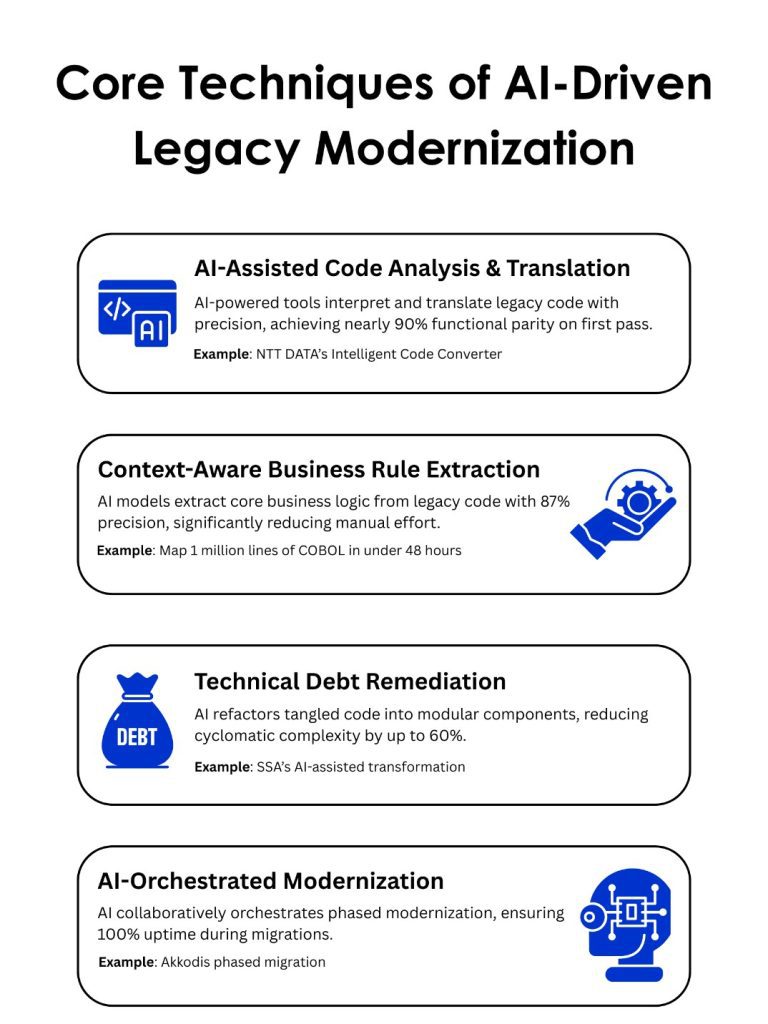
1. AI-Assisted Code Analysis & Translation
Today’s AI-powered code analysis tools are capable of interpreting and translating legacy programming languages like COBOL, RPG, or Delphi into modern languages such as Java or C# with remarkably high precision, often achieving accuracy rates above 89%. This is leagues ahead of older rule-based systems, which struggled with ambiguous logic and required heavy manual intervention.
Example: NTT DATA’s Intelligent Code Converter
Converted 500,000 lines of RPG to Java in just 72 hours, with nearly 90% functional parity on the first pass.
2. Context-Aware Business Rule Extraction
Today’s transformer-based models can understand code the way humans do—by recognizing patterns, dependencies, and intent.
With access to 14 million code repositories, AI can now:
- AI models extract core business logic from legacy code with 87% precision, significantly reducing manual effort.
- Map 1 million lines of COBOL in under 48 hours
- Surface 92% of embedded business rules automatically
3. Technical Debt Remediation with Reinforcement Learning
Instead of rewriting tangled code from scratch, AI can refactor it into modular components, reducing cyclomatic complexity by up to 60%.
Example: SSA’s AI-assisted transformation
The U.S. Social Security Administration reported saving $2.3 million annually by leveraging AI to restructure key legacy modules into maintainable units, eliminating the need for a complete rewrite.
4. Incremental Modernization via AI Orchestration
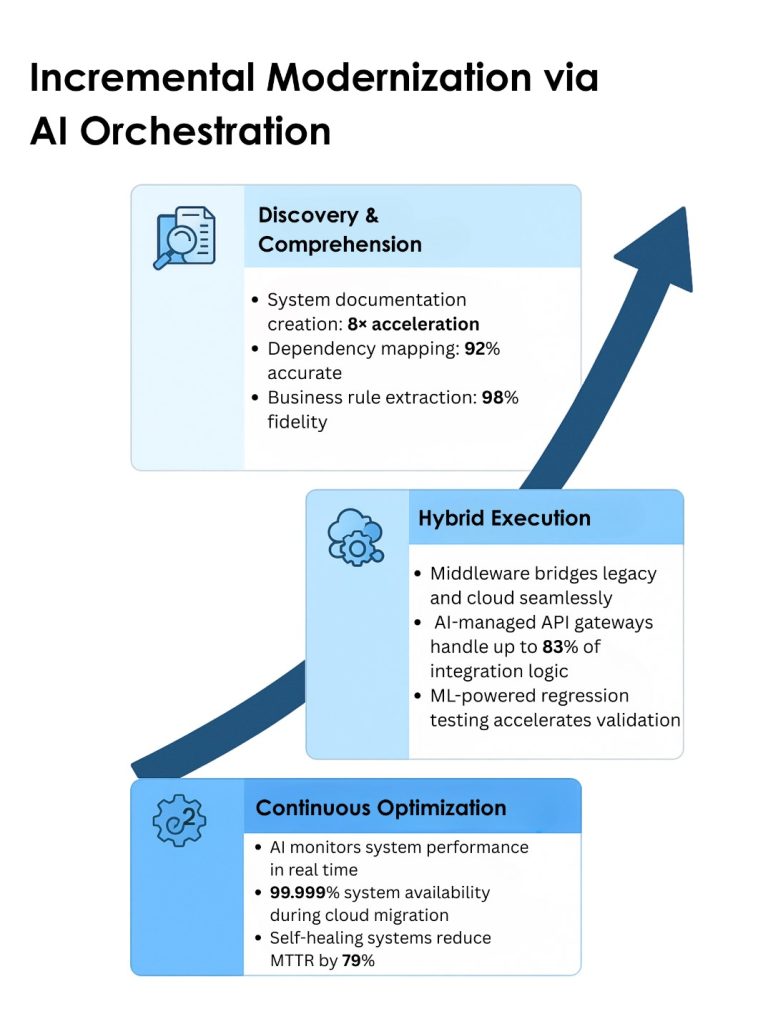
Phase 1: Discovery & Comprehension
- System documentation creation: 8x acceleration through AI-generated outputs
- Dependency mapping: 92% accurate
- Business rule extraction: 98% fidelity
Example: Thoughtworks’ reconstitution engine
Reduced discovery time from 9 months to 11 weeks for a major European bank.
Phase 2: Hybrid Execution
- Middleware bridges legacy and cloud seamlessly
- AI-managed API gateways handle up to 83% of integration logic
- ML-powered regression testing accelerates validation
Example: Akkodis phased migration
Migrated 142 modules in 18 months with 100% uptime for an automotive dealer network.
Phase 3: Continuous Optimization
- AI monitors system performance in real time
- Predictive maintenance flags issues before failures
- Self-healing capabilities reduce MTTR by 79%
Example: South Carolina Health Department
Achieved 99.999% system availability during cloud migration using AI-powered validation frameworks.
Best Practices to Implement the Middle Path
Strategic Prioritization Using the AI Impact Matrix
| Criteria | Weight |
| Business Criticality | 40% |
| Technical Debt Severity | 30% |
| Complexity to Modernize | 20% |
| ROI Potential | 10% |
Use Case: Tier 1 Bank
Applied the matrix and identified 68 high-impact components, delivering $14M in annual savings.
Risk Mitigation: Don’t Modernize Blindly
- AI-powered impact analysis forecasts dependency issues with 89% accuracy
- Hybrid test environments allow parallel runs and simulated regressions
- Continuous knowledge capture keeps system documentation current during transformation
Lesson: Think evolution, not explosion.
The Softura Advantage: Cognitive Modernization in Action
At Softura, we don’t just follow the middle path, we paved it.
Our Cognitive Modernization Platform (CMP) delivers AI-driven modernization at enterprise scale, anchored on three strategic pillars:
1. Legacy Comprehension Engine
- Processes 2M lines/hour across 48 languages
- Generates interactive maps with 95%+ accuracy
- Cuts discovery phase costs by 65%
2. Adaptive Transformation Framework
- Converts legacy logic into cloud-native code with 87% automation
- Ensures 100% compliance via embedded governance rules
- Deploys 73% faster than traditional rebuilds
3. Intelligent Operations Hub
- Predicts system anomalies with 92% precision
- Automates 83% of post-migration tasks
- Reduces Mean Time to Repair (MTTR) by 79%
Client Success Story: Global Insurance Leader
Modernized 18 legacy systems in 24 months, achieving:
- $28M cost savings
- 99.97% uptime
- 142% ROI in 18 months
The Future of Application Modernization Is Hybrid, AI-Driven, and Human-Led
Legacy modernization used to mean “rip and replace.” But modern enterprises know better. The future lies in adaptive evolution, where AI assists human teams in gradually transforming the old into something sustainable, scalable, and intelligent.
By 2027, Gartner estimates that 65% of enterprise modernization initiatives will use AI-assisted approaches, compared to just 22% in 2024.
Why?
- 3–5x faster time-to-value
- Up to 80% cost savings
- Lower risk than full rebuilds
The next frontier is self-modifying systems, where AI autonomously improves code through reinforcement learning. Early pilots show 40% autonomous optimization.
Final Thought: Break the Dilemma, Not the System
Legacy systems aren’t the enemy. Inflexibility is.
You don’t have to choose between expensive rebuilds or expensive stagnation. The AI-powered middle path lets you:
- Preserve what works
- Modernize what doesn’t
- Scale intelligently and affordably
At Softura, we help organizations like yours unlock transformation—not by starting over, but by moving forward with what you already have.
Let’s take the smarter path. Together.
Interested in AI-Driven Modernization?
Explore how forward-thinking enterprises are using AI-powered frameworks to modernize legacy systems without disruption. Want access to our AI Impact Matrix template or learn more about phased modernization techniques? Reach out to our editorial team to start the conversation.

Right Firms
23 May 2025


Latest Posts


Submit Your Inquiry
Related Posts

Sep 2026
Fraud Readiness for AI Built Payment Apps
AI-assisted development can reduce the time required to build a payment product, but it does not reduce the number of ways that product can be abused. A team may generate interfaces, APIs, tests, and transaction workflows in weeks. An attacker still needs only one authorization gap, exposed secret, weak recovery path, or overly powerful AI tool to move money or take over an account. The release question therefore has to change. It is no longer enough to ask whether the app works as designed. Leaders also need evidence that it fails safely when a user, bot, compromised account, or manipulated AI system behaves in ways the product team did not intend. The financial context is difficult to ignore. The Federal Trade Commission reported more than $12.5 billion in U.S. consumer fraud losses in 2024, up 25 percent from 2023. In Canada, federal authorities said consumers lost more than C$638 million to fraud in 2024 and estimated that only 5 to 10 percent of fraud was reported. Those figures cover a broad range of scams, not only weaknesses in payment apps, but they show the scale of the environment in which payment products now operate. AI Changes Development Speed Not Security Rules AI coding tools are good at producing plausible code. Plausible is not the same as secure. A generated endpoint may confirm that a user is signed in without confirming that the user owns the account or transaction being requested. This is a version of broken object-level authorization, which OWASP ranks first in its 2023 API security risks. A payment endpoint may trust a client-supplied amount, destination, currency, or account identifier instead of checking it against server-side records. The feature can pass a functional test while still exposing a route to fraud. The same problem appears in generated tests. AI can quickly cover the expected flow: log in, enter payment details, authorize the transaction, and receive confirmation. Fraud tends to live outside that path. Useful tests also need to attempt replay, parameter tampering, privilege escalation, duplicate submission, race conditions, invalid state changes, and recovery-flow abuse. Dependencies and configuration deserve equal attention. An assistant may suggest a package with a known vulnerability, use an abandoned library, place a secret in a repository, or generate a cloud role with broader permissions than the service needs. Code review must evaluate the security properties of the result, not the fluency of the output. Fraud Controls Belong in the Transaction Path A payment system needs controls across identity, device, session, beneficiary, and transaction data. Risk decisions may consider device reputation, transaction velocity, location changes, account history, behavioral signals, and relationships among accounts. The exact mix depends on the product, but the controls must operate where the transaction is authorized, not as a separate dashboard that reviews losses after they occur. Machine learning can identify patterns that fixed rules miss, but it cannot be treated as an unexplained approval engine. Teams need to monitor false approvals, false declines, model drift, decision latency, and the factors used in each decision. Analysts also need enough evidence to review a disputed transfer and understand why the system approved, challenged, or blocked it. Deterministic controls remain essential. A risk model should not override sanctions screening, transaction limits, step-up authentication, mandatory identity checks, or restrictions on newly added beneficiaries. High-risk transfers and disputed decisions need a defined path to human review. Account recovery deserves the same scrutiny as the main login flow. Attackers often target password resets, device changes, support escalation, and identity-recovery procedures because those paths can bypass stronger controls elsewhere. A system with excellent login security and weak recovery is still a weak system. Embedded AI Needs Narrow Permissions An AI feature inside the product creates a second class of risk. A support assistant may read transaction records or invoke account tools. A fraud-operations assistant may recommend a hold, release a payment, or change a risk threshold. Crafted instructions, manipulated files, or poisoned data can influence these systems. OWASP's 2025 guidance for language model applications identifies prompt injection and excessive agency among the main risks. The safest design assumes that model output is untrusted. Each AI component should receive only the data and tools required for its task. High-impact actions should require deterministic validation and, where appropriate, human approval. The system should record the instruction, context, tool request, authorization result, and final action so investigators can reconstruct what happened. A language model should not have independent authority to move money. The Release Gate Should Test Abuse A conventional release gate asks whether requirements are complete and expected tests pass. A fraud-aware gate asks what an attacker can change, repeat, race, impersonate, or bypass. That review begins with a threat model that traces the movement of identity, authorization, account, beneficiary, and transaction data through the system. The release evidence should include a dependency review, secret scanning, an authorization matrix, negative API tests, webhook signature and replay tests, rate-limit verification, account-recovery tests, and an incident exercise. Products with embedded AI also need adversarial tests for prompt injection, data leakage, tool misuse, and attempts to cross permission boundaries. Independence matters. The engineers who built a flow know how it is supposed to work, which can make unexpected abuse paths harder to see. A separate security team or qualified external tester should challenge the product with clear scope, realistic test accounts, and access to the architecture and business rules. The goal is not a ceremonial penetration-test certificate. It is evidence that the most consequential abuse cases have been examined and that critical findings are resolved before launch. Compliance Is a Baseline PCI DSS 4.0.1 provides a baseline for protecting cardholder data. It does not, by itself, show that an account-recovery flow resists impersonation, a webhook rejects replay attempts, or an AI assistant lacks excessive permissions. Compliance defines required controls within a particular scope. Fraud readiness tests how the complete product behaves when someone tries to abuse it. Other obligations vary by jurisdiction and business model. A U.S. operator may need to consider state privacy laws, money-transmitter requirements, partner controls, and breach-notification rules. A Canadian operator may need to consider PIPEDA, provincial privacy rules, anti-money-laundering obligations, and reporting requirements. Legal counsel should determine the applicable scope; the engineering team should be able to show how each requirement is implemented and monitored. What Executives Should Ask Before Launch Executives do not need to review every test case, but they should insist on direct answers to a few questions. Who can authorize or reverse a payment? Which values are trusted from the client, and which are recomputed on the server? How does the system detect a new device, beneficiary, or unusual transaction pattern? What can each AI component read and do? Which actions require human approval? How quickly can the team contain an attack and reconstruct the event? The answers should be supported by evidence rather than assurance. Useful measures include time to detect and contain fraud, false-decline rates, account-recovery outcomes, unresolved critical vulnerabilities, the age of open findings, model drift, and the proportion of sensitive actions covered by step-up authentication or manual review. No single metric proves safety, but together they show whether risk is being managed as an operating discipline. AI can help a smaller team build a capable payment product sooner. That advantage is real. It becomes durable only when the company applies the same speed to threat modeling, negative testing, permission design, monitoring, and incident response. A payment app is ready for release when leaders can explain how it resists abuse, show the evidence, and identify who is accountable when a control fails.

Sep 2026
AI Is Creating New Software Categories: 15 Fastest-Growing Development Services Businesses Are Searching For
Two years ago, "AI development" mostly meant one thing: bolt a chatbot onto a website or plug a model into an existing product. That single category has since split into more than a dozen distinct, specialized service lines, each with its own tooling, talent requirements, and buyer expectations. Businesses searching for a "generative AI developer" in 2026 are increasingly searching for something far more specific: a RAG specialist, an agent orchestration partner, a voice AI integrator, or a vertical AI platform builder. This is not a rebranding exercise. Gartner forecasts AI agent software spending alone will climb from $206.5 billion in 2026 to $376.3 billion in 2027, roughly 82% growth in a single year, a curve steep enough to justify its own category rather than sitting inside a general "AI development" line item. Here are the 15 software service categories seeing the fastest growth in demand right now, and why businesses are actually investing in each one. 1. AI Agents and Agentic Workflows AI agents, systems that can plan, act across multiple tools, and complete multi-step tasks with limited human review, have moved from pilot projects into production. Nearly 40% of enterprise applications are expected to embed task-specific agents by the end of 2026. Businesses are investing here because agents solve a different problem than chatbots: instead of answering a question, they complete a workflow, freeing staff from repetitive multi-step processes like ticket resolution, data entry, and routine approvals. 2. RAG Development (Retrieval-Augmented Generation) RAG systems connect a language model to a business's own documents, databases, and knowledge bases, so responses are grounded in accurate, current, company-specific information instead of a model's general training data. RAG system integration is now considered one of the fastest-growing professional AI services, alongside fine-tuning and data curation. Businesses invest in RAG development specifically to solve the hallucination problem, an AI tool that answers confidently but incorrectly is a liability, while one grounded in verified internal data is a genuine productivity tool. 3. AI Voice Assistants and Conversational AI Voice AI has moved well past scripted IVR menus into real-time, low-latency conversational systems that handle outbound calls, customer support, and telephony integrations, some with response times under 100 milliseconds. Businesses in healthcare, financial services, and customer support are investing heavily here because voice remains the highest-volume, highest-cost communication channel in most organizations, and even partial automation of first-line call handling produces immediate, measurable cost savings. 4. AI Copilots for Business Workflows Copilots, AI assistants embedded directly inside existing tools for writing, research, summarization, and meeting notes, are one of the most widely adopted AI categories precisely because they require no workflow change. Employees keep using the software they already know; the copilot layer just makes it faster. This low-friction adoption path is why copilot demand has outpaced more ambitious agentic projects for many businesses still early in their AI adoption journey. 5. Multimodal AI Development Multimodal AI, models that process text, image, audio, video, and structured data together rather than one input type at a time, is quickly becoming the baseline expectation in competitive healthcare, retail, and security applications. Businesses invest in multimodal development because real-world problems rarely arrive in a single format: a support ticket might include a screenshot, an insurance claim might include a photo and a form, and a retail search might combine an image with typed text. 6. Enterprise AI Platforms and Orchestration Layers As businesses adopt multiple AI tools at once (a copilot here, an agent there, a RAG system somewhere else) demand has grown for orchestration platforms that manage which model handles which task, route requests appropriately, and give IT teams a single point of control. This category exists because most enterprises did not plan their AI adoption as one coherent system, they built it piecemeal, and orchestration platforms are how they are now stitching those pieces together. 7. AI Governance and Compliance Tooling Governance has become the fastest-growing line item inside enterprise AI budgets, now claiming 8 to 12% of total AI spend, up from just 3 to 5% in 2024. Businesses further along in AI adoption are shifting spend toward auditing, access control, and model monitoring, not because they want to slow down, but because weak governance is now cited as the leading reason agentic AI projects get cancelled after deployment. 8. LLMOps and AI-Augmented MLOps Running AI models in production reliably requires a different operational discipline than traditional software: monitoring for model drift, managing prompt versions, tracking token costs, and maintaining accuracy over time as underlying data changes. This has matured into its own engineering specialty, distinct from both traditional DevOps and data science. Businesses invest here because an AI feature that worked well at launch can quietly degrade months later without dedicated monitoring in place. 9. Vector Databases and AI Memory Systems Every RAG system and most AI agents depend on a vector database to store and retrieve information efficiently, and a growing category of tools now focuses specifically on giving AI agents persistent memory, so a system remembers what worked in previous sessions rather than starting from zero each time. Demand here is growing directly alongside RAG and agent adoption, since neither category functions well without a solid memory and retrieval layer underneath it. 10. AI-Powered Software Testing and QA AI-augmented quality assurance, tools that generate test cases, detect edge cases a human tester might miss, and validate AI system outputs against expected behavior, has become part of the operational backbone required to keep AI systems accurate and reliable at scale. This category is growing because testing traditional software and testing AI-driven software are genuinely different problems; a QA process built for deterministic code does not catch the kind of failures that show up in probabilistic AI outputs. 11. Vertical AI Platforms Rather than general-purpose AI tools, businesses are increasingly investing in AI platforms built specifically for one industry, healthcare diagnostics, legal document review, financial underwriting, with domain-specific training data and compliance built in from the start. Healthcare in particular has become the largest vertical AI market by enterprise spending. Businesses choose vertical platforms over general-purpose tools because industry-specific accuracy and compliance requirements are hard to retrofit onto a generic model after the fact. 12. AI Search Optimization and Answer Engine Visibility As more buyers research vendors and products through AI chat tools and AI-generated search summaries instead of traditional search results, a new service category has emerged around optimizing content specifically for AI visibility, structuring information so it gets surfaced accurately inside AI Overviews, chatbot answers, and LLM-generated summaries rather than only traditional blue links. Businesses are investing here because a growing share of buyer research now happens inside an AI conversation, and content that isn't structured for that context simply doesn't get cited. 13. Synthetic Data Generation Many AI projects stall not because the model is wrong but because the business lacks enough clean, labeled data to train or fine-tune it properly. Synthetic data generation, creating artificial but statistically realistic training data, has become its own service category for exactly this reason, particularly in healthcare and financial services, where real customer data is often too sensitive or too limited to use directly for training. 14. AI Security and Red-Teaming As AI systems handle more sensitive tasks and more autonomous decision-making, a specialized security discipline has emerged around stress-testing AI systems specifically, probing for prompt injection vulnerabilities, data leakage, and adversarial manipulation, rather than applying traditional application security testing to a fundamentally different kind of system. This sits inside the broader governance spending increase, and businesses in regulated industries in particular are treating it as a prerequisite for production deployment, not an optional add-on. 15. Edge AI and On-Device Processing Not every AI workload belongs in the cloud. Edge AI, running models directly on local devices, cameras, sensors, or on-premise hardware, is growing as businesses look for lower latency, reduced ongoing inference costs, and better data privacy for use cases like manufacturing quality control or in-store retail analytics. Businesses invest here specifically to avoid the recurring cost and latency of sending every inference request to a cloud API, which adds up quickly at scale. The Pattern Behind All 15 Categories What connects every category on this list is specialization. Two years ago, a business needed one generalist AI developer. Today, a serious AI initiative touches several of these categories at once, a customer support project alone might require RAG development, a voice AI layer, governance tooling, and AI-specific QA, each requiring genuinely different expertise. This is exactly why generic "AI development" searches are giving way to more specific ones. Businesses that know which of these 15 categories their project actually needs are able to find and vet the right specialist far faster than those still searching for a single do-everything AI vendor. Finding the Right Specialist for Your Category If you have identified which of these categories your project falls into, the next step is finding a partner with genuine, verifiable experience in that specific area rather than a broad AI development claim. RightFirms' AI development company directory lets you filter by technology focus and verified client reviews, and the AI-powered recommendation tool can match your specific requirements, whether that's RAG development, agent orchestration, or vertical AI expertise, against vetted profiles rather than a generic search. AI development is no longer one category. It is 15 and counting, and the businesses moving fastest in 2026 are the ones treating it that way.

Jul 2026
Why AI Projects Fail Before Development Even Begins: 10 Mistakes Businesses Keep Making
Most AI project post-mortems focus on the wrong stage. Teams blame the model, the data pipeline, or the vendor's technical delivery, when the actual failure happened weeks or months earlier, before a single line of code was written. The pattern shows up so often across enterprise AI adoption that it is worth naming directly: AI projects rarely fail because the technology did not work. They fail because the business never defined what "working" meant in the first place. Here are the 10 mistakes that show up most consistently before development even starts, and what to do instead. 1. Starting With the Technology, Not the Problem "We need to use AI somewhere in the business" is not a project brief, it is a mandate looking for a use case. Teams that start with a technology (generative AI, computer vision, an LLM feature) instead of a business problem end up building something impressive that nobody asked for. The fix is boring but effective: write down the specific decision, task, or bottleneck the project should improve, and only then ask whether AI is the right tool for it. Sometimes a simple rules-based automation or a better dashboard solves the same problem for a fraction of the cost. 2. Vague or Shifting Objectives "Improve customer experience with AI" cannot be scoped, budgeted, or tested. Objectives that lack a measurable outcome (reduce average response time by X, cut manual review hours by Y, improve forecast accuracy by Z percent) leave both the internal team and any AI development companies bidding on the work guessing at what success looks like. Every AI project planning phase should produce one paragraph that a non-technical executive could read and know exactly what "done" means. 3. Treating Data Quality as a Development-Phase Problem By far the most common and most expensive mistake. Businesses assume that once a vendor is hired, the vendor will "clean the data" as part of development. In practice, discovering that customer records are duplicated, labels are inconsistent, or historical data was never captured in a usable format often happens three or four weeks into a project, after the budget and timeline have already been fixed. A data audit, however basic, should happen before a contract is signed, not after. If nobody in the business can currently answer "how many complete, usable records do we have for this exact use case," that is the first project to run, not the AI model. 4. Unrealistic Expectations About What AI Can Actually Do Executive sponsors frequently picture a finished, self-correcting system from day one, based on demos of consumer AI products built by teams with vastly larger data and engineering resources. A first AI project inside a mid-sized business is closer to a working prototype that improves over several iterations. Setting expectations around a minimum viable model, with a clear plan for retraining and improvement cycles, prevents the "this doesn't work" verdict that often lands on a system that was never expected to be perfect on day one. 5. No Internal Owner for the Project AI projects that are sponsored by leadership but have no single accountable owner inside the business tend to stall at the handoff points: providing data access, reviewing model outputs, approving changes in scope. Vendors can only move as fast as the client-side decisions allow. Before development starts, name one person (not a committee) who owns data access, feedback, and sign-off. 6. Skipping a Proof of Concept Committing to a full build before validating the core assumption (that the available data can actually predict or generate what the business needs) is a common and costly mistake. A short, scoped proof of concept, even a two to four week exercise on a sample dataset, tells you far more about feasibility than any vendor proposal document. If a company will not agree to a small proof of concept before a large contract, that itself is worth treating as a warning sign during AI consulting or vendor conversations. 7. Choosing a Vendor Based on Buzzwords Instead of Relevant Experience "AI-powered," "cutting-edge," and "end-to-end solutions" appear on nearly every agency's homepage. What actually predicts delivery success is prior, verifiable experience with a similar problem type and a similar data environment, not a long list of frameworks. When comparing AI development companies, ask for a case study that matches your industry and your data maturity level, not just your industry. A firm that has built recommendation engines for retail may have no relevant experience building a document classification system for a legal team, even though both fall under "AI." 8. No Plan for What Happens After Launch AI systems degrade. Data drifts, customer behavior changes, and a model that performed well at launch can quietly become less accurate six months later without anyone noticing, because nobody owns monitoring. Businesses that treat AI as a one-time delivery project, rather than a system that needs an ongoing feedback loop, often find the project rated a failure a year later, not because the build was bad but because nobody maintained it. 9. Underestimating Change Management Even a technically flawless AI tool fails if the people who are supposed to use it do not trust it or were not involved in shaping it. Support agents who were never consulted on an AI ticket-routing tool will find workarounds. Underwriters who do not understand how a risk model reached its output will override it by default. Any AI strategy needs a plan for training, communication, and incorporating frontline feedback, not just a technical rollout plan. 10. Rushing Vendor Selection to Hit a Deadline Perhaps the most avoidable mistake: choosing a vendor in a week because a budget needs to be spent or a board deadline is approaching. Rushed vendor selection skips reference checks, skips the proof of concept, and skips a real conversation about data readiness. A platform like RightFirms' AI development directory exists precisely to shorten this process without skipping it, since verified reviews and detailed company profiles let a business compare experience and delivery track record in hours rather than weeks of cold outreach. What to Do Instead: A Pre-Development Checklist Before signing with any vendor or greenlighting an internal build, a business should be able to answer: What specific business outcome are we trying to improve, in measurable terms? Do we have a named internal owner for data access and sign-off? Have we audited our own data for completeness and quality? Have we validated the core assumption with a small proof of concept? Does the vendor have relevant experience, not just AI experience in general? Who is responsible for monitoring and retraining after launch? Have the people who will use this system been part of shaping it? Answering these honestly, before a single meeting with a vendor, resolves the vast majority of AI project failures that get blamed on development later. Where to Go From Here If your business is early in the planning stage, it is worth talking to an AI consulting partner before writing a full requirements document, since an experienced firm can help pressure-test the objective and data readiness questions above before any budget is committed. RightFirms' list of top AI consulting companies is a reasonable place to start that conversation, and its AI-powered shortlist tool can match your specific requirements against verified profiles rather than a generic search. AI projects do not fail in development nearly as often as businesses assume. They fail in the weeks before development starts, when the objective was still vague, the data was still unaudited, and the vendor was still chosen for the wrong reasons. Fix that stage, and the technical build has a real chance of succeeding.